English



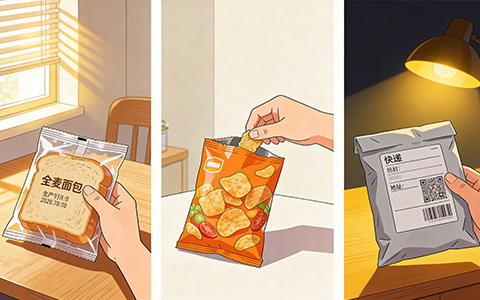
In the morning, you pick up a loaf of bread — the production date on the package is clear and smudge-free. At noon, you tear open a bag of snacks — the printed design is vivid, and the ink at the heat-sealed edge has not migrated to the food. In the evening, you receive a parcel bag — the address QR code scans instantly, not faded by friction during delivery.
Behind these "taken-for-granted" moments lies a silent battle between ink and film.
PET, CPP, PE, PVC — each film has its own "temperament." Some are "too slippery" for ink to adhere properly, requiring customized ink formulations tailored to substrate characteristics. Others have internal oils and substances that migrate to the surface, causing color bleed and distorted graphics. Through integration, absorption, and encapsulation, we "protect" the ink.
Ink on film is more than decoration. It must withstand retort processing, high-temperature lamination, boiling water resistance, high scratch resistance, and resistance to various media — all without contaminating the package contents. Working together with the packaging material, it provides barrier against grease and oxygen, protecting the contents and fulfilling the package's mission.
Some ink grades become tacky when heated, causing bags to stick together and fail to open. Others dry too slowly in high-humidity workshops, reducing production efficiency and increasing scrap rates. Ultimately, your packaging print quality depends on the degree of matching among the ink system, substrate, resin, and additives.
LINGWE does not manufacture ink — but we provide the core materials that make ink "stick firmly, dry fast, and last long": our specialty acrylic resin series for water-based inks. These are not universal solutions, but systematic tools that address adhesion, durability, and printability at the molecular level.
Three Everyday Scenarios That Reveal Ink Pain Points
Scenario 1: Appearance on Supermarket Shelves
Shrink-sleeve labels on beverage bottles, condiments, and personal care products require crisp graphics and smooth application. Insufficient ink adhesion can cause cracking and whitening during heat shrinking. Poor water resistance can lead to label blistering from condensation in refrigerated environments.
- POLYCOAT® Waterborne Resins
- WBA5002S (High Versatility): Alcohol-soluble acrylic resin with good adhesion, flexibility, and heat anti-blocking performance
- WBA5126 (Special Modified Self-Crosslinking Type): High gloss, excellent color development, water resistance, and chemical resistance. Suitable for surface printing on PE, OPP, PET, and PVC shrink films
Scenario 2: Barcode Scannability on Express Bags
Barcodes on e-commerce express bags require adequate abrasion resistance. During transport, friction can partially blur barcodes, reducing sorting machine recognition efficiency.
- POLYCOAT® Waterborne Resins
- WBA5002S (High Versatility): Alcohol-soluble acrylic resin with cost-effective performance
Scenario 3: Safety in Food and Daily Product Contact
PE packaging bags that directly contact food or skin require ink that is non-toxic, low-migration, and resistant to high-temperature heat sealing. Residual monomers or solvent odors in the ink can migrate to the contents, causing consumer discomfort or compliance risks. This is a critical packaging safety consideration that requires strict control.
- POLYCOAT® Waterborne Resins
- WBA5003 (Higher Softening Point): Alcohol-soluble acrylic resin balancing adhesion, flexibility, and heat anti-blocking, with excellent cost-performance
- WBA5180 (Special Modified Self-Crosslinking Type): Good pigment wetting and dispersion, high gloss, and excellent heat anti-blocking properties
LINGWE POLYCOAT® Specialty Acrylic Resins for Water-Based Inks
Addressing the above pain points, LINGWE offers two major resin series: waterborne acrylic emulsions and alcohol-water acrylic resins, covering scenarios including surface printing, reverse printing, primer coating, and resin modification.